Web news · Security · Case study
Cloudflare Turnstile: how to protect your contact forms from spam
Fake quote requests, inconsistent details, meaningless messages: here is how Agence Web POP stopped spam on a client's forms with Cloudflare Turnstile and a honeypot.
8 min readBy Alina Pop
A contact form is essential on a professional website. It lets visitors ask questions, book an appointment or request a quote. But when it is not properly protected, it can also become an entry point for bots that automatically send unwanted messages.
Fake quote requests, inconsistent contact details, meaningless messages: these submissions clutter business inboxes and make it harder to handle genuine sales enquiries.
Several mechanisms can be combined to solve this problem. Among them, Cloudflare Turnstile and a honeypot form a particularly effective pair to protect forms while keeping the user experience smooth.
Why do contact forms attract spam bots?
Publicly accessible forms can be targeted by automated programs able to fill in and submit data without any human involvement.
These bots are not trying to become clients. They may be used to spread advertising, send unwanted links or simply multiply automatic submissions.
For a business, the consequences are concrete:
- Many emails with no commercial value.
- Time lost identifying genuine requests.
- Risk of missing an important message among unwanted ones.
- Cluttered notifications sent from the website.
- Poorer follow-up of prospects and quote requests.
The problem can affect a simple contact form as well as a multi-field quote request form.
The solution is to identify and block automated submissions before they generate useless notifications.
Cloudflare Turnstile: anti-spam protection suited to professional websites
Cloudflare Turnstile is a verification system designed to tell legitimate interactions apart from automated behaviour. It can be integrated into a form to check that a submission shows the expected characteristics of a human interaction.
Unlike older CAPTCHA systems that often asked users to recognise images or solve puzzles, Turnstile favours generally unobtrusive checks. Depending on context, a small widget may appear near the form's submit button.
How does Cloudflare Turnstile work?
When a visitor uses a protected form, Turnstile runs a check and produces a token that must be validated on the server. It works in several steps:
- 1The visitor fills in the form.
- 2Turnstile runs its check.
- 3The form sends the data and the verification token to the server.
- 4The server verifies the token with Cloudflare.
- 5The request is processed only if the required checks pass.
This server-side validation is essential: simply displaying the widget on a page is not enough to secure form processing.
What are the benefits for a business?
- Fewer unwanted automated submissions.
- Generally unobtrusive verification for visitors.
- Can be integrated into websites built with modern technologies.
- Protects forms without systematically imposing complex visual challenges.
- Several forms can be secured on the same website.
For a professional website the goal is twofold: reduce spam while making it easy to send genuine sales enquiries.
Honeypot: an invisible field to detect some bots
A honeypot is a complementary anti-spam technique based on a simple principle: an extra field is added to the form, designed not to be used by legitimate visitors.
Some bots systematically fill in every field they detect in the page code. When they fill in this trap field, the server can identify a suspicious submission.
How does a honeypot work?
- 1A trap field is added to the form.
- 2A normal visitor does not fill it in.
- 3An unsophisticated bot may fill it in automatically.
- 4The server detects the value and rejects the submission.
A honeypot filters some attempts without asking anything extra of the visitor. It is not enough on its own, however: some bots can recognise and avoid this kind of field. That is exactly why it is worth combining it with another verification system.
Why combine Cloudflare Turnstile and a honeypot?
The two mechanisms complement each other.
| Protection | Main function |
|---|---|
| Cloudflare Turnstile | Check that an interaction is legitimate and validate a token on the server |
| Honeypot | Detect some automated submissions with a trap field |
| Both combined | Multiply checks before processing a request |
Combining them strengthens protection without turning the form into a complicated journey. A business needs a simple, quick form: effective anti-spam protection must not become an obstacle for prospects.
Case study: no more spam on a client's forms
Context: a renovation website receiving fake quote requests
Our client is a company specialising in renovation work, mainly in the Paris region. Its website lets visitors contact the company and request a quote. Two forms are available:
- A contact form.
- A quote request form.
These forms play an important role in generating sales leads. However, the client was receiving emails corresponding to fake requests with inconsistent information.
The problem observed
One of the notifications looked like a standard quote request: a project type (bathroom), an estimated budget and a preferred timeframe. But the name, city and message were strings of random characters.
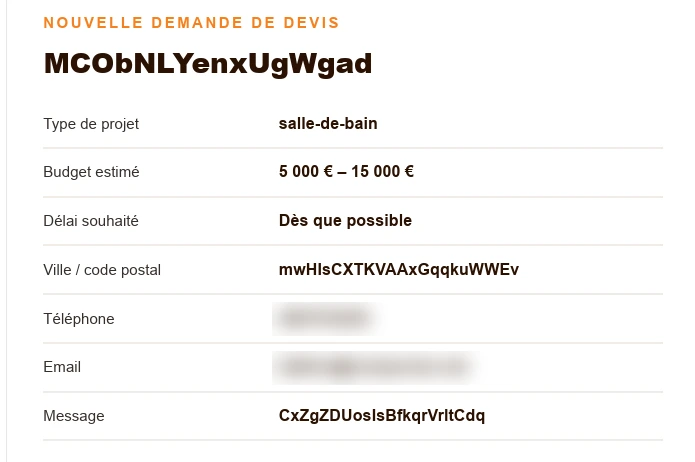
This kind of message is particularly annoying when it copies the usual layout of the website's emails: the business has to open each notification before realising it is spam.
Our intervention: two protections on both forms
To solve the problem, Agence Web POP added two layers of anti-spam protection:
- 1Cloudflare Turnstile: a verification built into the forms, validated on the server before any processing.
- 2Honeypot: a trap field to detect and discard some automated submissions.
The protections were applied to both entry points, the contact form and the quote form, while keeping it easy for genuine clients to send their requests.
The result: problem solved, the client confirms the spam has stopped
The client's reply after our intervention
“Hello, yes, it has stopped.”
This confirmation is the observed result of our intervention: the spam messages reported earlier no longer reached the client at the time of their reply. It was not just about installing a technical tool, but about solving a problem that directly disrupted a business's day-to-day work.
How to secure a contact form on a Next.js website
On a website built with Next.js, protection must be designed both in the interface and in server-side processing. Integrating Cloudflare Turnstile can follow these steps:
- 1Configure a Turnstile widget for the domain.
- 2Add the verification component to the form.
- 3Retrieve the token on submission.
- 4Verify the token on the server with Cloudflare's validation service.
- 5Check the honeypot field.
- 6Validate the other form data.
- 7Only allow requests that pass the checks before sending the email.
Secret keys and sensitive checks must stay on the server. Other mechanisms can also be added, such as rate limiting, strict data validation or error monitoring.
A form's security therefore does not depend only on the visible component: it also depends on how the application processes the data. That is the approach of our custom web development.
Cloudflare Turnstile or Google reCAPTCHA: which to choose?
Cloudflare Turnstile and Google reCAPTCHA share a similar goal: limiting abusive automated interactions. The choice depends on the website's architecture, privacy requirements, integration constraints and the desired user experience.
Cloudflare Turnstile is particularly interesting when you want generally unobtrusive verification, with server-side validation and without systematically imposing visual challenges.
No single solution guarantees the permanent elimination of all spam. Combining several mechanisms remains relevant for forms that play an important commercial role.
Protecting your forms means protecting your business opportunities
A contact form is not just a design element. For a tradesperson, a renovation company, a professional practice or an SME, it is often one of the main ways to receive new prospects.
When it is flooded with automated messages, the problem goes beyond technology: it eats into sales follow-up time and makes genuine requests harder to spot. Anti-spam protection is therefore part of a professional website's overall quality, just like maintenance.
At Agence Web POP, we build these concerns into our approach to web development: performance, SEO, user experience and reliable features. Our work on this client's forms shows that a targeted solution can fix a concrete problem faced by a business.
FAQ: Cloudflare Turnstile and anti-spam protection
Is Cloudflare Turnstile free?
Cloudflare offers a free Turnstile plan, subject to the limits and conditions of that plan. Paid options also exist depending on needs.
Does Cloudflare Turnstile work with Next.js?
Yes. It can be integrated into a Next.js application, provided the token is verified on the server.
Is a honeypot enough to block all spam?
No. It detects some bots, but others can avoid trap fields. Combining it with Turnstile strengthens protection.
Why do we receive fake quote requests?
Public forms can be targeted by bots that automatically submit fictitious data. Without proper checks, these submissions can generate emails that look exactly like genuine requests.
Can Cloudflare Turnstile block real clients?
Like any automated verification system, it can encounter difficult checks or errors. The integration must therefore be tested to limit unjustified blocking.
Should every form on a website be protected?
Public forms that can send emails or store requests deserve suitable protection, especially contact, quote and sign-up forms.
Is your form receiving spam?
Receiving fake quote requests or automated messages from your website? Agence Web POP builds and optimises professional websites with Next.js and can improve the reliability and protection of their forms.
Portfolio
Discover some of the websites built by Agence Web POP
Coaches, tradespeople, dentists, renovation, finance, transport, cosmetics… See our projects in pictures.
See our work