Landing page · Google Ads · Meta Ads · Conversion
Landing page design: improve the conversion of your advertising campaigns
Are you investing in Google Ads, Facebook Ads, Instagram Ads or LinkedIn Ads campaigns, but your visitors are not turning into enough leads or customers?
The performance of an advertising campaign does not depend only on targeting, budget or the quality of the ads. It also depends on the page people land on after clicking your ad.
A conversion-optimised landing page creates a consistent journey between your ad and the action you want: a quote request, a phone call, a sign-up, an appointment or a purchase.
At Agence Web POP, we design custom landing pages built to support your advertising campaigns and make the most of your marketing investment.
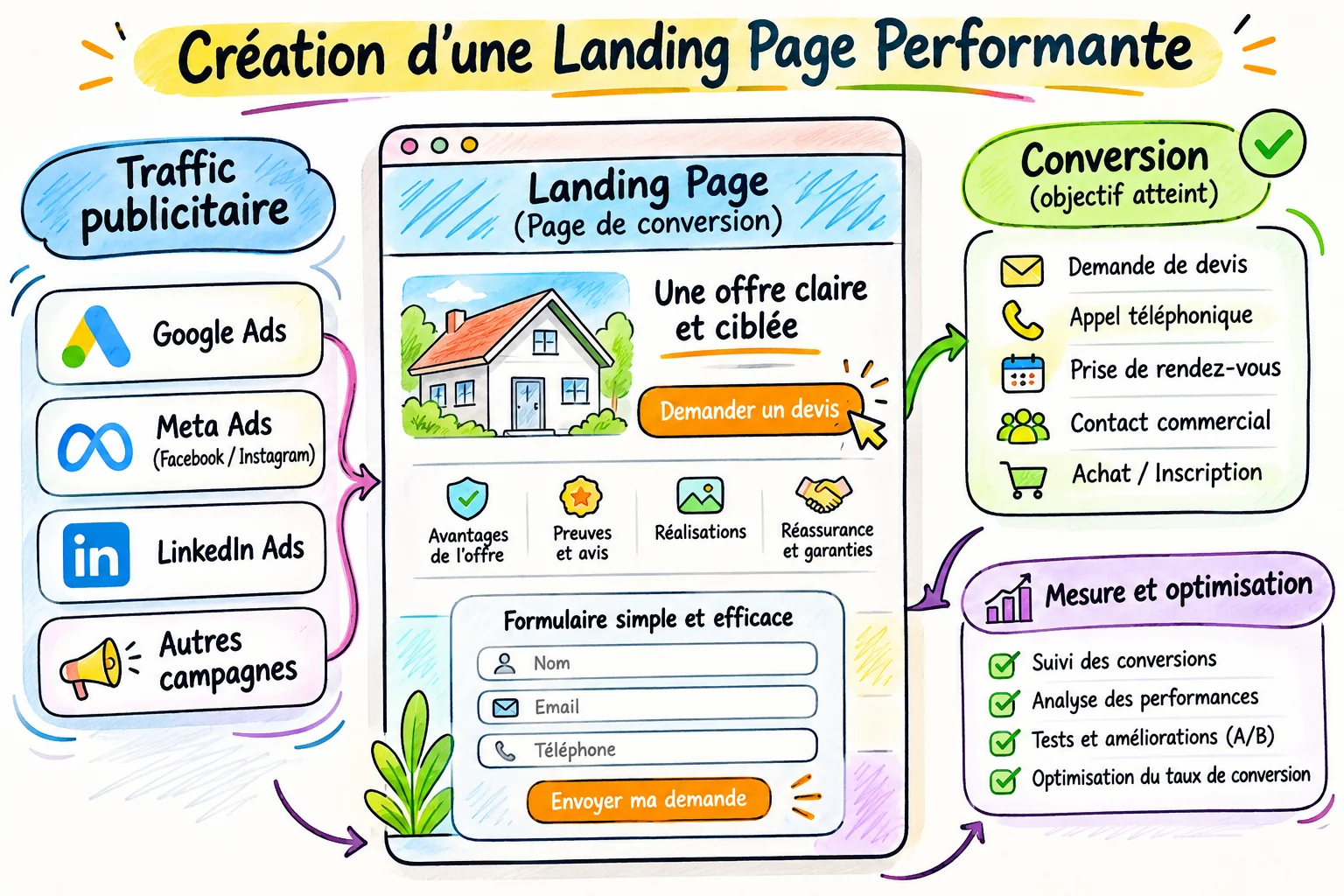
What is a conversion landing page?
A landing page, also called a destination page, is a web page a visitor is sent to after clicking a link, an ad or a button.
Unlike a standard website page, a conversion landing page is usually built around one specific business goal.
It can be used to:
- Generate quote requests.
- Obtain qualified sales leads.
- Encourage phone calls.
- Present a promotional offer.
- Generate appointment bookings.
- Encourage event registrations.
- Sell a product or service.
Its structure, content and design are built to guide the visitor towards that action.
Building a landing page is therefore not simply about creating an attractive page. It is about building a user journey focused on a measurable result.
Why create a dedicated landing page for your ad campaigns?
When a business launches an ad campaign, every click is a business opportunity, but also a cost.
Always sending visitors to the website's home page can limit the campaign's effectiveness.
A visitor who clicks an ad for a specific service expects to find information about that offer straight away.
If they have to browse several menus, look for a service or find the right form themselves, the risk of abandonment increases.
A dedicated landing page removes these intermediate steps and presents directly:
- The service the visitor is looking for.
- The benefits of the offer.
- Trust signals.
- Answers to the main questions.
- A simple way to take action.
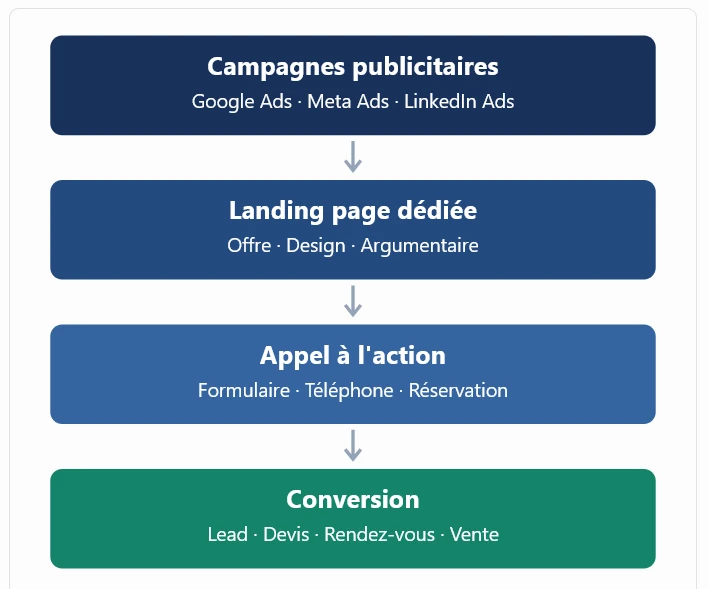
The goal is to turn ad traffic into business opportunities without adding unnecessary steps.
Landing page or home page: what are the differences?
| Home page | Conversion landing page |
|---|---|
| Presents the whole company | Presents one specific offer or service |
| Offers several navigation paths | Focuses on one main goal |
| Speaks to different visitor profiles | Meets the expectations of a targeted audience |
| Contains many internal links | Limits unnecessary distractions |
| Develops the general brand presentation | Encourages a specific business action |
A landing page complements the existing website. It does not necessarily replace its corporate or service pages.
Landing page design for Google Ads
A Google Ads campaign reaches people who are actively searching for a product, a service or a solution to a problem.
The landing page must match that search intent precisely.
Take the example of a roofing company running a campaign on the following French search terms:
- « Rénovation toiture » (roof renovation).
- « Réparation toiture » (roof repair).
- « Couvreur Paris » (roofer Paris).
- « Devis toiture gratuit » (free roofing quote).
The page visitors are sent to must directly present the services concerned, the areas covered and the option to request a quote.
The stronger the consistency between the search, the ad and the landing page, the faster the visitor understands they are in the right place.
The relevance and usefulness of the content, ease of navigation and the experience offered on the landing page can also contribute to the landing page experience assessed by Google Ads.
A high-performing landing page therefore contributes to the campaign's overall effectiveness, although it cannot on its own guarantee a lower advertising cost.
Landing page design for Meta Ads and social media
Ad campaigns on Facebook, Instagram, LinkedIn or TikTok do not always match the same intent as search engine campaigns.
On social media, people may discover an offer when they were not actively looking for the service.
The landing page must therefore continue the ad's message and let the visitor quickly understand why the offer is worthwhile.
In particular, it should:
- Repeat the promise made in the ad.
- Keep visual and editorial consistency.
- Present the benefits immediately.
- Reassure the visitor about the company's reliability.
- Offer a simple, accessible action.
- Provide a particularly smooth mobile experience.
An attractive ad can generate many clicks. However, if the landing page does not meet the expectations created by the ad, part of the business potential may be lost.
A landing page for Meta Ads must therefore be designed hand in hand with the campaign itself.
The essential elements of a high-performing landing page
An effective conversion page relies on several complementary elements: strategy, design, content, usability and technical performance.
1. A clear headline and an immediate value proposition
Within the first few seconds, the visitor must understand:
- What the company offers.
- Which need the service meets.
- What benefits they can expect.
- What action they can take.
A precise headline paired with a relevant value proposition avoids overly generic messages.
2. Conversion-focused design
The design of a landing page should make reading easy and naturally guide the eye to the essential information.
A clear visual hierarchy highlights the offer, the benefits, the trust signals and the action buttons.
The aim is not to pile on visual effects, but to create a professional, reassuring and intuitive interface.
3. Effective calls to action
CTAs, or calls to action, must match the campaign's goal.
For example:
- Request a free quote.
- Describe my project.
- Book an appointment.
- Request a call back.
- Book now.
- Discover the offer.
Their wording, placement and visibility directly shape the quality of the user journey.
4. An optimised contact form
A conversion form should let visitors send the necessary information without an unnecessarily complex journey.
Depending on the business, the form may ask for:
- The type of project.
- The location.
- The desired timeframe.
- A description of the need.
- Contact details.
- Additional information useful for qualifying the request.
The number of fields should match the business goal. A form that is too long can put some visitors off, while one that is too short may produce poorly qualified leads.
Validation and anti-spam protection can also be built in to limit automated submissions.
5. Trust signals
A visitor who discovers a company through an ad does not necessarily know its reputation.
The landing page can include various elements that build trust:
- Genuine customer reviews.
- Photos of completed projects.
- Project examples.
- Professional certifications.
- Applicable guarantees.
- Information about the company.
- An explanation of how the service works.
These elements must be real, verifiable and suited to the business sector.
6. A fast, mobile-friendly page
A large share of traffic from social media ad campaigns may come from smartphones.
The landing page must therefore offer smooth navigation on mobile devices.
This means in particular:
- Optimised images.
- Controlled loading times.
- Easily reachable buttons.
- Forms suited to small screens.
- A responsive structure.
- Keeping unnecessary scripts and elements to a minimum.
A slow or hard-to-use page can make visitors leave before they have even seen the offer.
Case study: a landing page for Maison Elite
A conversion page dedicated to a Meta Ads campaign
Maison Elite is a roofing company working mainly in Val-de-Marne, Paris and Hauts-de-Seine.
For an advertising campaign launched on Meta, Agence Web POP designed a specific landing page to receive the traffic from the ads and make it easier to request quotes for roofing work.
Rather than sending visitors to the company's general home page, the campaign directs them to a page entirely dedicated to their roofing project.
The business goal is clearly defined: let visitors describe their need and send a quote request.
A structure designed to make contact easy
The Maison Elite landing page combines a free quote offer, a directly accessible qualification form and information that helps visitors decide.
It lets visitors select different types of work, including renovation, repair, roof framing, insulation and zinc work.
Visitors can enter their location and contact details, then send their request.
The page also shows photos of completed jobs, customer reviews, information on guarantees and an overview of the project steps.
Together, these form a dedicated journey, from discovering the offer to sending the request.
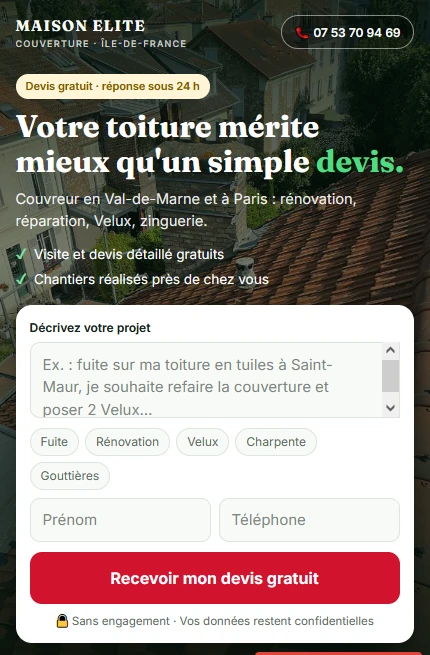
You can also visit the page directly to see how it works.
View the Maison Elite landing page (in French)
This project illustrates our approach to professional landing page design: building a page suited to the campaign's goal and the nature of the service offered.
Conversion rate optimisation: how do you measure results?
Conversion rate optimisation (CRO) means improving a web page's ability to turn visitors into leads or customers.
It relies on analysing behaviour, performance and any obstacles encountered along the user journey.
A landing page can receive a large volume of traffic without generating enough business results.
The number of visits alone is therefore not an indicator of success.
How do you calculate a landing page's conversion rate?
The conversion rate is the share of visits that generated the desired action.
Conversion rate = (Number of conversions / Number of visits) × 100
For example, if a landing page receives 1,000 visits and generates 30 quote requests, its conversion rate is 3%, counting one conversion per converted visit.
The conversion goal must be defined before the campaign launches.
It may be a form actually submitted, a confirmed booking, a purchase or another measurable action.
How does the conversion rate affect your ad budget?
Take a fictitious example of two landing pages with the same ad budget and the same average cost per click.
| Indicator | Landing page A | Landing page B |
|---|---|---|
| Ad budget | €500 | €500 |
| Average cost per click | €1 | €1 |
| Number of clicks | 500 | 500 |
| Measured visits | 500 | 500 |
| Conversion rate | 2% | 5% |
| Requests generated | 10 | 25 |
| Ad cost per request | €50 | €20 |
In this simulation, the second page generates 2.5 times more requests with the same ad budget.
The ad cost per request falls from €50 to €20, a 60% reduction.
This example is theoretical and assumes every click produces a measurable visit. It is not a performance guarantee.
It does show why optimising a landing page can have a significant impact on an ad campaign's profitability.
Which indicators should you track?
| Indicator | Purpose of the analysis |
|---|---|
| Ad clicks | Measure interactions with the ads |
| Landing page visits | Identify the traffic actually measured |
| Conversion rate | Assess the effectiveness of the journey |
| Forms submitted | Measure the requests sent |
| Phone number clicks | Identify intentions to call |
| Cost per lead | Assess the ad cost of one request |
| Qualified leads | Measure the business relevance of contacts |
| Sales made | Assess the business results achieved |
It is also important to distinguish a simple button click from an actual conversion.
A visitor may click a contact button without submitting the form. Likewise, a click on a phone number does not necessarily mean a call went through.
Tracking must be configured with these differences in mind.
Why do my ads get clicks but few customers?
An ad campaign can generate a large number of clicks without achieving the expected business results.
Several factors can explain this.
A mismatch between the ad and the landing page
If the ad presents a specific offer but the landing page is too general, the visitor may quickly lose interest.
Ad targeting that is not precise enough
A high-performing landing page cannot fully make up for poorly targeted ads.
Traffic quality also plays an essential role in generating leads.
A user journey that is too complex
Forms that are hard to fill in, buttons that are hard to see or excessive navigation can hold back conversion.
Insufficient technical performance
Slow loading or display problems on mobile can cause visitors to leave.
A lack of trust signals
A lack of information about the company, its projects or other reassurance can make visitors hesitate.
The analysis must therefore cover the whole journey, from the ad to the moment of contact.
Why don't ad clicks always match the number of visits?
The statistics from ad platforms and from website analytics tools can differ.
An ad click does not necessarily correspond to a visit that was actually loaded or recorded.
Several situations can explain the difference:
- A visitor clicks an ad several times.
- The visitor closes the page before it finishes loading.
- The internet connection drops.
- The browser blocks some tracking scripts.
- The visitor refuses analytics cookies.
- The tools use different counting methods.
- Some clicks are interactions that do not lead directly to the website.
It is therefore important to compare equivalent indicators, for example outbound clicks to the website and visits measured on the landing page.
A large gap deserves a technical and analytical investigation. It should not automatically be blamed on the campaign or the website.
Setting up conversion tracking
A dedicated landing page makes it possible to set up tracking suited to the ad campaign's goals.
Depending on the business's needs, several tools can be used:
- UTM parameters to identify where traffic comes from.
- Google Analytics.
- Google Ads Conversion Tracking.
- Meta Pixel.
- Meta Conversions API.
- Custom events for forms and buttons.
- Tracking of booking or purchase confirmations.
These tools must be integrated and configured in line with the applicable personal data protection and consent requirements.
The aim is to have relevant information to analyse performance and identify possible improvements.
A landing page for every business goal
Building a landing page must always start from a precise goal.
Lead generation landing page
Suited to service companies, tradespeople and B2B providers, it collects the information needed for a sales contact.
Quote request landing page
It presents a service and makes it easy for the prospect to describe their need so a personalised estimate can be prepared.
Appointment booking landing page
It guides the visitor towards a booking system or an online calendar.
E-commerce landing page
It presents a product, a collection or a specific offer and encourages purchase.
Event landing page
It presents an event, a trade show, a training course or a webinar and centralises registrations.
Email campaign landing page
It receives visitors from a professional newsletter and continues the message presented in the email.
A single business can therefore have several conversion pages, each suited to a campaign, a service or a specific audience.
Ad landing pages and SEO: what are the differences?
A page designed for an ad campaign does not necessarily pursue the same goals as a page built for SEO.
An SEO page aims to meet a search intent and gain lasting organic visibility in search engines.
An ad landing page usually favours a more direct journey focused on one specific business action.
| SEO page | Ad landing page |
|---|---|
| Organic traffic acquisition | Mainly paid acquisition |
| Content that meets search intents | Content focused on a targeted offer |
| Long-term visibility growth | Conversion goal tied to a campaign |
| Internal linking and semantic coverage | Simplified user journey |
| Analysis of impressions, clicks and rankings | Analysis of leads and cost per conversion |
A landing page can also be optimised for SEO when its content and positioning justify it.
However, some purely advertising pages may need a different indexing strategy to avoid duplication and overlap with existing SEO pages.
How much does a professional landing page cost?
The price of a landing page depends on several factors:
- The complexity of the design.
- The level of customisation.
- Creating or integrating the content.
- The form's features.
- Technical integrations.
- Conversion tracking.
- Maintenance and optimisation needs.
- The number of variants the campaigns require.
The cost of building the landing page should also be distinguished from the budget spent on running the ads.
A professional landing page is a reusable asset that can support several ad campaigns when they pursue compatible goals.
At Agence Web POP, we study your project to propose a solution suited to your business, your advertising strategy and the features you need.
Why entrust your landing page to Agence Web POP?
We treat building a conversion page as a project combining several skills: digital strategy, design, web development, user experience and performance analysis.
Our support can include:
- 01Analysing your offer and business goals.
- 02Identifying the campaign's target audience.
- 03Defining the conversion journey.
- 04Designing the landing page structure.
- 05Creating a custom design.
- 06Developing with modern web technologies.
- 07Integrating forms and calls to action.
- 08Optimising the mobile display.
- 09Configuring conversion tracking as needed.
- 10Technical testing before going live.
We can also work on an existing website to add a specific conversion page, without requiring a full redesign.
The landing page then becomes a complementary part of your digital acquisition strategy.
FAQ — Landing page design and conversion rate optimisation
What is a conversion landing page?
It is a web page designed to guide a visitor towards a specific action, such as a quote request, a sign-up, a booking or a purchase.
Why create a landing page for Google Ads?
A dedicated page presents content directly linked to the ad and the visitor's search intent. It can make the ad journey more consistent and make conversion easier.
Can you create a landing page for Facebook Ads and Instagram Ads?
Yes. A landing page dedicated to Meta Ads campaigns continues the ad's message, presents the offer and makes it easier to get in touch.
Should each campaign have a different landing page?
It depends on the services, audiences and goals. When several campaigns present different offers, specific pages can be worthwhile.
What is a good conversion rate for a landing page?
There is no universal conversion rate. Results vary by sector, traffic quality, offer, service price and the desired action.
How do you improve a landing page's conversion rate?
Improvements can come from a clearer value proposition, simpler forms, better technical performance, trust signals or testing different versions of the page.
Why do I get many ad clicks but few quote requests?
Several factors may be involved: poor targeting, a mismatch between the ad and the page, technical problems, a complex form or an offer that is not convincing enough.
Can a landing page be added to an existing website?
Yes. A landing page can be added to the company's existing domain, provided its technical architecture is compatible.
Can a landing page be used for a newsletter campaign?
Yes. It can receive traffic from an email campaign and offer an offer, a form or content directly linked to the message sent.
Does a landing page guarantee new customers?
No. It optimises the conversion journey, but results also depend on the quality of the campaigns, audience expectations, the commercial offer and how requests are handled.
Turn your ad clicks into business opportunities
Are you investing in Google Ads, Facebook Ads, Instagram Ads or other ad campaigns?
Is your landing page really designed to turn your visitors into leads?
At Agence Web POP, we build custom professional landing pages suited to your campaigns and business goals.
Don't settle for generating traffic. Give your visitors a clear path to take action.
You may also like
- Custom web developmentNext.js websites, React interfaces, API integrations and business features.
- Website design for tradespeopleProjects, quote forms and local SEO for construction trades.
- Website design for the self-employedA professional website for sole traders and micro-businesses.
- Professional website designOur complete method for building professional websites.
- Web applicationsClient portals, booking systems and business tools built with React.
- Website redesignModernise an existing website and migrate it to Next.js.
- Our workAll our live websites, presented by sector.
Portfolio
Discover some of the websites built by Agence Web POP
Coaches, tradespeople, dentists, renovation, finance, transport, cosmetics… See our projects in pictures.
See our work